A good book club is part literature seminar, part dinner party, and part therapy session. People come for the book, stay for the conversation and leave with three new recommendations. If you run a book club, or you are about to start one, this invitation gives each meeting its own little announcement: what you are reading, where you are meeting, and what to bring.
A Shelf Full of Spines
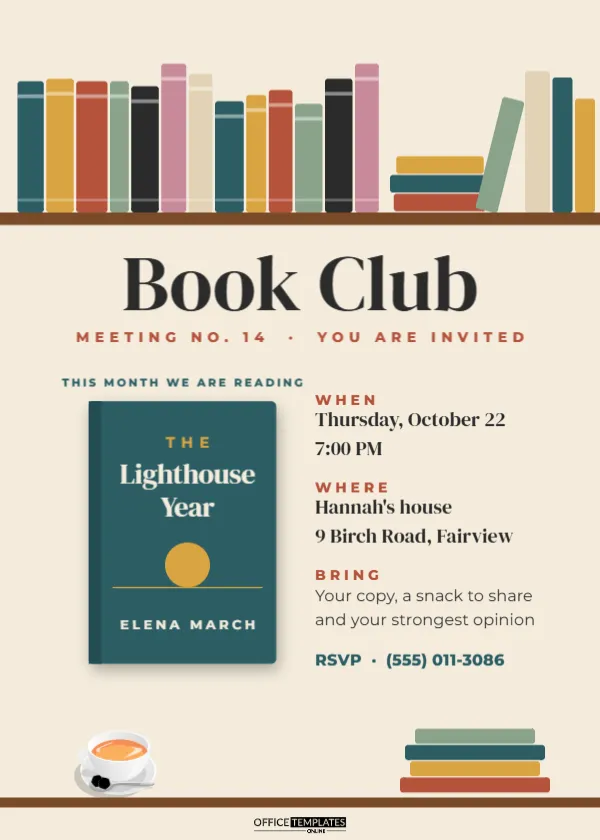
The top of this 5 x 7 inch card is a bookshelf. Rows of book spines in deep teal, mustard, rust, sage, charcoal, dusty pink, and parchment stand on a wooden shelf, with a short horizontal stack and one book leaning at an angle, just like a real home library. Below the shelf, Book Club is set in large DM Serif Display, with Meeting no. 14, you are invited in rust capitals.
The lower half has two columns. On the left, under This month we are reading, a teal book cover shows the title The Lighthouse Year by Elena March, with a mustard sun and horizon line; this is a sample, and you can type your own title and author. On the right, three short blocks labelled WHEN, WHERE, and BRING give the meeting details, followed by an RSVP number. At the bottom, a smaller shelf holds a teacup and a stack of four books, echoing the shelf at the top, with the OTO logo underneath.
Swapping in Your Book’s Cover
The book cover on the card is drawn from shapes and text, so you can match it to your own book without needing an image. Double-click the title and author to type them, then change the cover colour to roughly match the real book. Many book clubs prefer this approach because it looks consistent from month to month. If you would rather show the actual cover, add your own image of the book from the editor and place it over the drawn cover. Make sure you have permission to use any cover image you upload.
Discussion Starters for Any Book
Some meetings flow by themselves. Others need a nudge. Keep a few open questions ready, or print them on the back of the invitation for members to think about beforehand:
- Which character would you most like to have dinner with, and why?
- Was there a moment where you nearly stopped reading? What kept you going?
- How did the setting shape the story? Could it have happened anywhere else?
- Did the ending feel earned? How would you have ended it?
- What did you underline or photograph to remember?
- If this book were a film, who would play the lead?
- Would you recommend it to a friend? Which friend?
- What question would you ask the author?
A good host lets everyone speak once before the most talkative members get a second turn.
Book Club Rhythms That Work
| Format | How it runs | Best for |
|---|---|---|
| Rotating host | Each member hosts and picks the book in turn | Groups of friends |
| Fixed venue | Always the same café, library or bar | Larger or newer groups |
| Theme year | A theme each month: classics, memoirs, translated fiction | Groups wanting variety |
| Vote-in | Members suggest three books and vote | Groups with mixed tastes |
| Silent reading club | An hour of reading together, then a chat | Busy readers who struggle to finish |
Editing the Shelf, Colours and Fonts
Every line is editable: change the meeting number, the date and time, the host and address, and what to bring. The bookshelf at the top is a single grouped object; you can recolour it to match your club’s favourite colours, or ungroup it to change individual spines. The footer stack is grouped too. The teacup is editable vector art, so you can recolour it from its swatches or swap it for a wine glass if your club prefers that kind of beverage.
The fonts are DM Serif Display for the title and the details, and Montserrat for the small labels. Both are Google Fonts available in the editor.
Snacks, Drinks and Literary Themes
Many clubs match the food to the book. A novel set in Italy suggests bruschetta and Chianti; a Victorian mystery calls for tea and scones; a beach read deserves lemonade. The BRING line on the card is perfect for this: Your copy, a snack to share, and your strongest opinion is the sample, but Something the main character would eat makes an excellent prompt.
Starting a Brand New Book Club
If this is your first meeting, use the card to set expectations clearly. Change Meeting no. 14 to Our very first meeting and choose a book that is widely available, not too long, and easy to talk about; a well-reviewed novel of about 300 pages is ideal. Invite more people than you need, because some will drop out once the reading starts. At the first meeting, agree on the basics together: how often you meet, how books are chosen, and whether the host provides food or everyone brings something. Keep a shared list of books read and books suggested, so the next choice is always easy.
Getting the Card to Members
Book clubs often meet monthly, so a digital invitation is the most practical. Download the card as a PNG or JPG and share it in your group chat or email list. If you meet at a library or bookshop, a printed version on cream card (download the PDF) looks lovely pinned to a noticeboard and can attract new members. Print several at once and update only the book and date each month.
Book Club FAQs
How many members should a book club have?
Six to twelve active members is ideal. Fewer and meetings get cancelled; more and not everyone gets to speak.
What if members have not finished the book?
Agree on a spoiler policy. Many clubs discuss the first half early and the ending last, so everyone can join.
How long should a meeting be?
Two hours: thirty minutes of catching up and food, an hour on the book, thirty minutes choosing the next read.
Type in this month’s book, set the date, and send the card. Your next great conversation is already on the shelf.