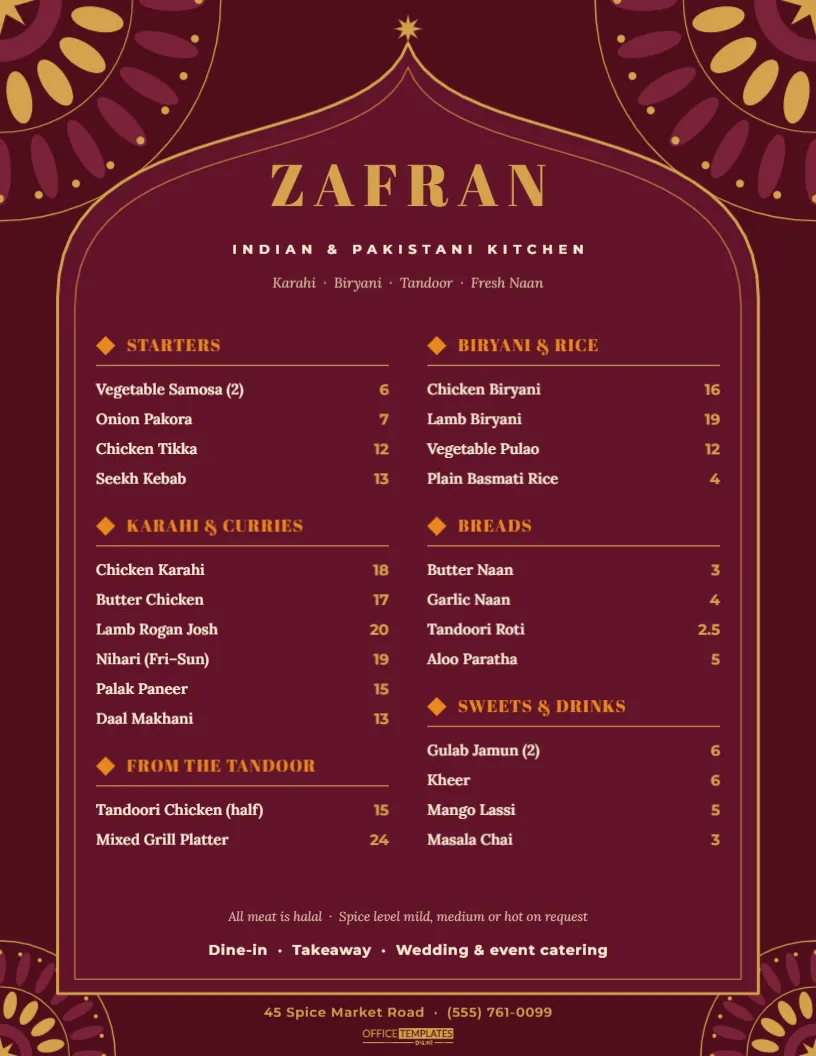
Desi food is generous, aromatic, and full of colour, from sizzling karahi to fragrant biryani and fresh naan straight from the tandoor. Your menu should feel the same. This Indian and Pakistani Restaurant Menu Template frames the dishes inside a golden Mughal arch, the shape you see in the gateways of historic mosques, palaces and havelis across South Asia, set on a deep maroon background with mandala medallions glowing in the corners. It is elegant enough for a fine-dining room and clear enough for a busy takeaway counter.
Arches, Mandalas and Saffron
The page is US Letter, 8.5 x 11 inches, portrait. The background is a deep, velvety maroon. Rising in the middle is a tall ogee arch, the pointed onion-shaped arch typical of Mughal architecture, filled with a slightly lighter wine colour and outlined in gold with a second fine gold line inside it. A small gold eight-pointed star crowns its tip.
In the two top corners, large gold mandala medallions spread into the space beside the arch: rings of rose-coloured and gold petals, fine gold dots and a star at the centre. Smaller mandalas sit in the bottom corners, so the page is framed on all four sides.
Inside the arch, ZAFRAN (the Urdu and Hindi word for saffron) is set in large gold Abril Fatface capitals. Under it, INDIAN & PAKISTANI KITCHEN appears in cream capitals and Karahi · Biryani · Tandoor · Fresh Naan in soft italics. The menu is in two columns, each section opened by a small saffron diamond and a saffron heading over a gold rule:
- Left: Starters (samosa, pakora, chicken tikka, seekh kebab), Karahi & Curries (chicken karahi, butter chicken, lamb rogan josh, weekend nihari, palak paneer, daal makhani) and From the Tandoor.
- Right: Biryani & Rice, Breads (butter and garlic naan, tandoori roti, aloo paratha) and Sweets & Drinks (gulab jamun, kheer, mango lassi, masala chai).
Near the base of the arch are a note about halal meat and spice levels and a line offering dine-in, takeaway and wedding catering. Beneath the arch, the address and phone number are set in gold, with our gold logo at the bottom centre.
A Spice Level Guide for Your Guests
One of the most common questions in any desi restaurant is: How spicy is it? Many restaurants cook to order, as the template’s note says, but a guide on the menu helps new guests choose confidently. You can add a short version under the halal note or print this on the back:
| Level | What to expect | Dishes that are usually here |
|---|---|---|
| Mild | Warm spices, very little chili; creamy and gentle | Butter chicken, daal makhani, kheer, mango lassi |
| Medium | Noticeable warmth that builds slowly | Chicken tikka, palak paneer, biryani, rogan josh |
| Hot | Fresh green chilies and plenty of red chili | Karahi (on request), seekh kebab with chutney |
| Desi hot | Full-strength heat, the way many home kitchens cook it | Any karahi or curry, if you ask the chef |
Spice varies from kitchen to kitchen and region to region, so adjust the examples to match your own recipes.
Personalizing the Menu
- Restaurant name: double-click ZAFRAN and type your name, perhaps Lahori Darbar, Chandni Chowk, or Spice Garden. Up to about ten letters fit on one line at this size.
- Dishes: each line has a name and a price. Rename sections to suit your menu, for example Handi instead of Karahi, Chaat Corner for street snacks, or Nihari & Paye for weekend specials.
- Prices: type them in your local currency. The template shows plain numbers, which suit dollars, pounds, or rupees.
- Colours: change the maroon to deep emerald or royal blue for a different mood. The arch fill and outline change separately, and each mandala is one group, so it recolours in one step.
- Service line: replace Wedding & event catering with your own offers, such as Family platters, Lunch buffet daily, or Order online.
Menu Wording for Desi Dishes
- Keep the real names: Karahi, nihari, paratha, and gulab jamun are dishes people search for by name. Don’t replace them with translations.
- Add a hint for newcomers where it helps: Nihari (slow-cooked beef stew, Fri-Sun).
- Mark vegetarian dishes: Many guests look for them first. A small (V) after paneer, daal, and chana dishes is enough.
- State halal clearly: The template’s note does this, and many families check before ordering.
- Show weekend specials: Dishes like nihari, haleem, or paye are often weekend-only. Say so in brackets so guests know when to visit.
Printing a Dark, Rich Menu
Deep maroon and gold look luxurious when printed well. For the best result, download the PDF and have it printed at a copy shop on 100–120 lb matte card. Matte keeps the gold legible under restaurant lighting. At home, use your printer’s best quality setting on matte photo paper, and let the pages dry before stacking. For takeaway bags, a simpler black-and-white copy of the menu section can be printed cheaply, and the full-colour version kept for dine-in tables and the counter.
Restaurant Owners Ask
Can I add Urdu or Hindi dish names?
Yes, add them in a second line or beside the English name. Choose a font that supports Urdu (Nastaliq or Naskh) or Devanagari, and check the preview before printing.
Is this suitable for a wedding or mehndi menu?
Very much so. Remove the prices, change the name to the couple’s names or Mehndi Night, and the arch and mandalas become a beautiful menu card for each table.
Can I fit a lunch buffet price?
Add a line under the halal note, such as Lunch buffet daily 12 – 3 pm · 14.99, or replace the service line with it.
What if my menu has more dishes?
Use Add Page for a second page with the same maroon background, or shorten some sections on this page and put family platters and extras on the back.
Your Table Awaits
Write in your house specialties, set your prices, and let the golden arch welcome guests to your table. Print it for dine-in, share it online, and hand it to catering clients.