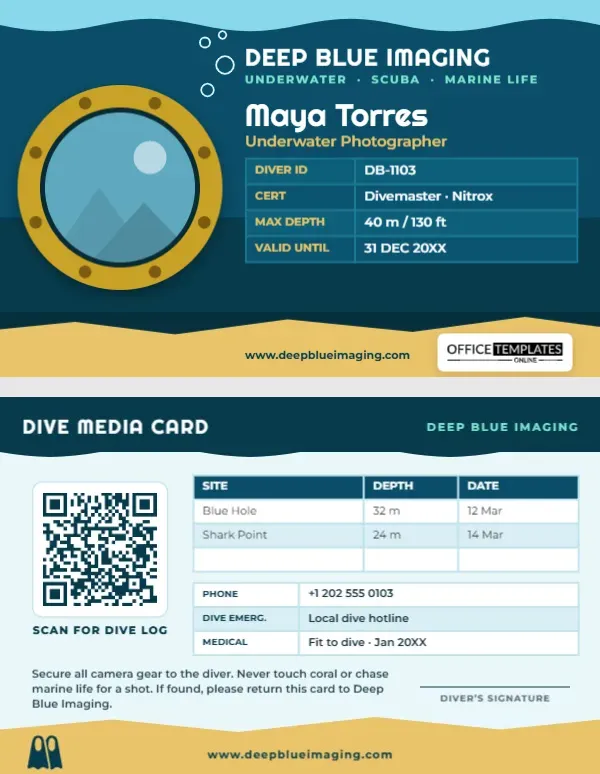
Underwater photographers live between two worlds: the dive boat, the resort, and the dive shop above the surface, and the reef below it. Up top, people want to know who you are, what you are certified for, and who is responsible for you. This Underwater Photographer ID Card handles that part so you can concentrate on the part below. It is a horizontal card in deep ocean blues with your photo inside a ship’s brass porthole, and it doubles as a compact dive media credential with a small log of recent dives on the back.
A Porthole Onto the Reef
The card is 3.375 inches wide and 2.125 inches high, the CR80 size of a credit card, laid out in landscape. The front is ocean from top to bottom. A pale aqua band of waves ripples along the top edge like the surface seen from just below; the water deepens through two darker bands, and a warm sandy seabed with a gently uneven edge forms the bottom of the card.
On the left, a thick brass porthole ring with eight dark bolts frames a round photo of you, the way a ship’s window frames the sea. Small white bubbles rise from the porthole towards the top right, as if you had just exhaled. On the right, DEEP BLUE IMAGING is set in Righteous, a rounded retro display face, with Underwater · Scuba · Marine Life in aqua capitals. Your name, Maya Torres, on the sample is large and white, with Underwater Photographer in sand yellow. A translucent teal table lists your diver ID, certification (Divemaster · Nitrox on the sample), maximum depth, and expiry date. Your website and our logo sit on the sand at the bottom.
Dive Media Card: The Back
- Header: DIVE MEDIA CARD in white on a dark teal band with a wave edge, and the studio name in aqua on the right.
- QR code:Scan for dive log, perfect for linking to your online logbook, portfolio, or certification record.
- Recent dives: a real table with site, depth, and date: Blue Hole at 32 m and Shark Point at 24 m on the sample, plus a blank row.
- Safety table: phone, a dive emergency contact, and a medical line such as Fit to Dive · Jan 20XX.
- Conduct note: secure all camera gear to the diver, never touch coral or chase marine life for a shot, and return the card if found.
- Footer: a sandy seabed with a pair of dive fins, your website and a signature line.
Camera Housing Checks Before You Roll Off the Boat
A lanyard card is small, but the routine behind it matters. Many underwater photographers print a card like this for the boat and keep this housing checklist in their head (or on a second card in their dry box):
- Clean and inspect every O-ring for hair, sand, and nicks; lubricate lightly if your housing maker recommends it.
- Check that the battery is charged and the memory card has space before you close the housing.
- Close all latches and run the vacuum or leak test if your housing has one.
- Dunk the camera in the rinse tank at the surface and watch for bubbles before you descend.
- Confirm strobe arms are tight and strobes fire, and that the lens port is clean.
- Clip the camera to your BCD with a lanyard so it cannot drift away or drag on the reef.
- After the dive, rinse in fresh water, dry before opening, and log the dive on your card or app.
Filling In Certification and Depth
The CERT and MAX DEPTH rows are what dive operators look at first. Use the exact name of your certification from your training agency, for example Advanced Open Water, Rescue Diver, Divemaster or Instructor, and add specialties that matter to photography such as Nitrox or Deep Diver. Set MAX DEPTH to the depth your training allows, not the deepest dive you have ever done; the sample shows 40 m/130 ft, the limit commonly associated with recreational deep diver training. Your card is a personal credential and does not replace your certification card from the training agency, which dive centres will still ask to see.
Making the Porthole Card Yours
- Photo: click inside the porthole and choose Replace Image. An above-water headshot is best for recognition; save your underwater selfies for the portfolio.
- Studio name and tagline: retype DEEP BLUE IMAGING and the aqua line, for example, Reef · Wrecks · Macro.
- Tables: select any table and use Edit Data. On the back, + Row adds more dives.
- QR code: change its link in the Barcodes & QR panel.
- Fins icon: the fins are an editable vector; recolour them from the swatch or swap them for another icon.
- Colours: for tropical water, lighten the blues to turquoise; for cold-water wrecks, shift them to deep green.
Who Carries a Dive Media Card
Underwater photographers and videographers working with dive resorts and liveaboards, dive shop staff who photograph courses for their customers, marine biologists and citizen-science survey divers, underwater models and safety divers on film shoots, and photo pros who teach underwater photography workshops all find it useful. Dive clubs can adapt it as a member card with a club name and member number.
Printing a Card That Lives Near Water
Salt spray, wet hands, and sunscreen will destroy a paper card in a week. Print on PVC if you can, or laminate a cardstock print with a thick pouch and round the corners so they do not peel. Deep blues can print darker than on screen, so check that the white text and the sand-coloured roll line stay bright. Keep the card on a stretchy coil lanyard or in a small waterproof pouch clipped to your gear bag on the boat.
Diver Questions
Can I list more than one certification agency?
Yes. Use the CERT row for your highest level and add a row with + Row for a second agency or instructor number.
Should the emergency line be a person or a hotline?
List whichever you would want called: a partner or friend on land, or the diving emergency service you are a member of.
Can I remove the bubbles?
The bubbles are one small group of circles; select and delete them, or move them next to the porthole on the other side.
Open the template, put your portrait in the porthole, enter your certification and dives, and head for the boat with a card that belongs by the water.