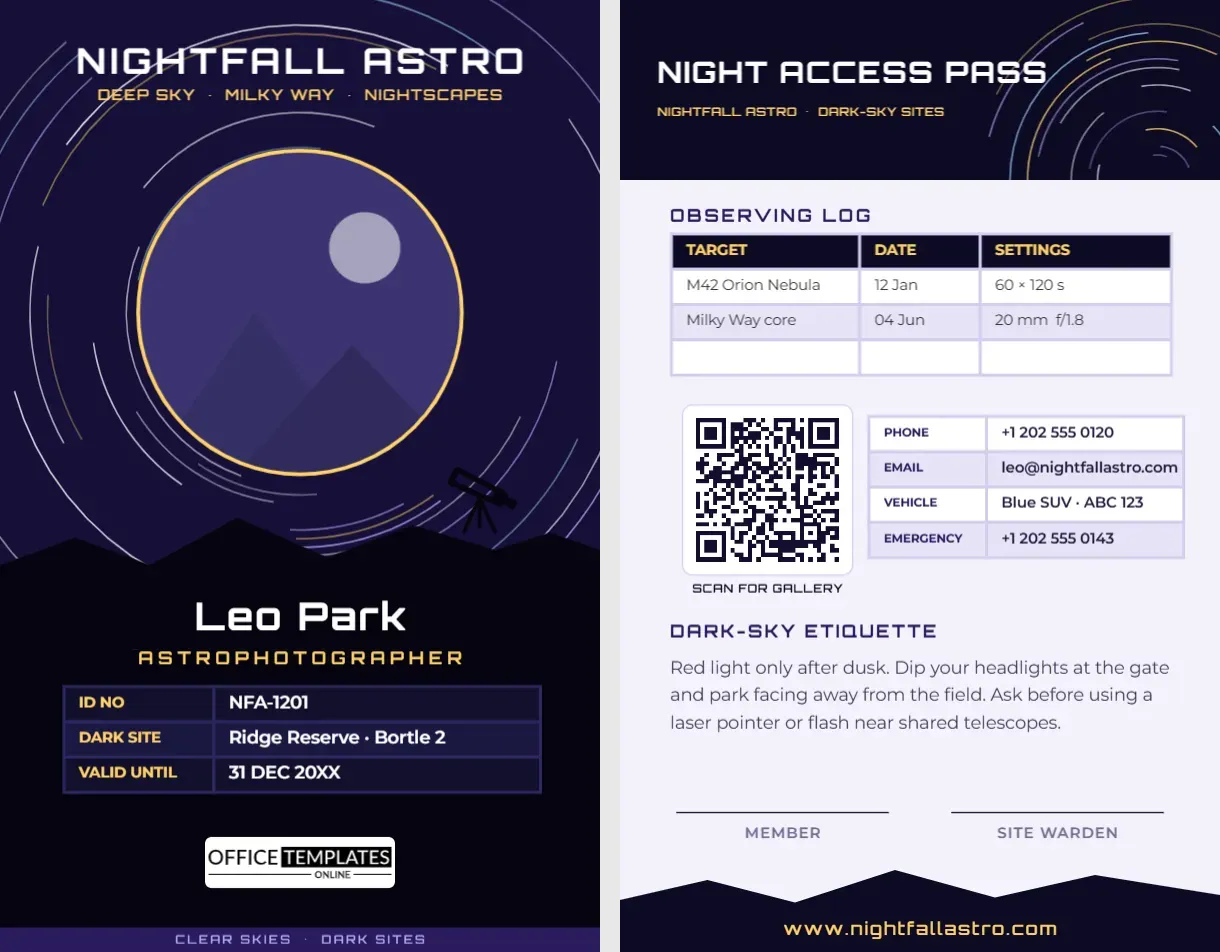
At two in the morning on a mountain road, a car full of tripods, telescopes, and red headlamps looks suspicious to almost everyone. Rangers, landowners, farmers and dark-sky park staff often want to know who is out there and why. For astrophotographers, a clear ID card is a small thing that makes night work easier: it gets you through a locked gate, reassures an observatory host and gives the club treasurer a reason to smile. This Astrophotographer ID Card turns the sky itself into the design, with your portrait at the centre of a whirl of star trails.
Star Trails Around Your Portrait
The front is a deep midnight blue with a hint of violet, the colour of the sky an hour after sunset. Around the middle of the card, dozens of thin curved lines circle a single point in white, lilac, pale blue and gold, exactly like the star trails you capture with a long exposure pointed at the celestial pole. At their centre is your round photo, outlined in gold, as if the whole sky were turning around you.
At the top, NIGHTFALL ASTRO is set in Orbitron, a geometric, space-age typeface, with Deep Sky · Milky Way · Nightscapes in gold. Lower down, a black mountain horizon cuts across the card, and on one of its ridges stands a small telescope on its tripod, pointed up at the trails. The ground below the mountains is nearly black and holds your details: your name, Leo Park on the sample, in white Orbitron, the word ASTROPHOTOGRAPHER in widely spaced gold letters, and a dark three-row table with your ID, your dark sky site, and the expiry date. Our logo sits on a white plate, and a violet band along the bottom edge reads CLEAR SKIES · DARK SITES.
It is a portrait CR80 card, 2.125 x 3.375 inches.
What the Bortle Number on Your Card Means
The DARK SITE row on the sample reads Ridge Reserve · Bortle 2. The Bortle scale describes how dark a sky is, from 1 (the darkest) to 9 (inner city). It is a handy shorthand on a card because every astrophotographer understands it:
| Bortle class | Sky type | What you can expect |
|---|---|---|
| 1 | Excellent dark site | Milky Way casts faint shadows; zodiacal light is obvious |
| 2 | Typical truly dark site | Milky Way highly structured; clouds appear black |
| 3 | Rural sky | Some light glow on the horizon; Milky Way still detailed |
| 4 | Rural and suburban transition | Light domes over towns; Milky Way visible but less detailed |
| 5-6 | Suburban skies | Milky Way weak or only visible overhead |
| 7-9 | Urban and inner city | Milky Way invisible; planets, the Moon and bright stars only |
Night Access Pass and Observing Log
The back opens with a night-blue header where more star trails curve from the top right corner, and NIGHT ACCESS PASS is written in white with Nightfall Astro · Dark-Sky Sites in gold. Below it:
- Observing Log: a real table with target, date, and settings, for example M42 Orion Nebula on 12 Jan at 60 × 120 s, and the Milky Way core on 04 Jun at 20 mm f/1.8, plus a spare row.
- QR code:Scan for gallery, ready to link to your astrophotography portfolio or an online image archive.
- Contact table: phone, email, vehicle (so a site warden recognises your car in the dark) and an emergency number.
- Dark-Sky Etiquette: red light only after dusk; dip headlights at the gate and park facing away from the field; ask before using a laser pointer or flash near shared telescopes.
- Signatures for the member and the site warden, above a mountain silhouette and your website in gold.
Why the Vehicle Row Matters
At a dark site, people arrive in the dark, leave in the dark, and park in fields without lights. Wardens and landowners often keep a list of expected vehicles so that an unknown car at 3 a.m. does not become a police call. Putting your car’s colour and plate on your card, and showing it when you register, is a small courtesy that makes regular access much easier to keep. Some clubs even ask members to leave a copy of their card on the dashboard.
Changing the Night Sky Details
- Portrait: click inside the gold ring and choose Replace Image. A photo of you beside your telescope under a starry sky suits the theme perfectly.
- Name and title: replace NIGHTFALL ASTRO with your business, club, or observatory, and change ASTROPHOTOGRAPHER to NIGHTSCAPE PHOTOGRAPHER or CLUB MEMBER if needed.
- Tables: select any table and click Edit Data to update your ID, site, log, or contact details.
- Star trails: the trails on each side are one grouped object. Recolour it or reduce its opacity; you can also rotate it to change where the gaps fall.
- Telescope: the telescope is an editable vector; recolour it from its swatch or swap it for a camera on a tripod.
- QR code: link it in the Barcodes & QR panel.
Who Uses an Astro Card
Astrophotographers selling prints or running night photography tours, amateur astronomy clubs that manage a private dark site, public observatories issuing volunteer IDs, star party organisers who need to recognise registered attendees, and planetarium staff who lead outreach nights all benefit. Club secretaries can print a batch of cards with member numbers in the ID row and a club QR code on the back.
Printing Deep Night Colours
Dark blue and violet can print almost black on some printers, which hides the star trails. Print a test card first and, if the trails look faint, increase their opacity slightly in the editor. PVC gives the richest blacks. Laminated cardstock works well too, and a matte finish avoids glare when someone shines a red torch on your card at the gate. Punch the slot above the title, in the empty sky, so the trails stay intact.
Stargazer Questions
Can I show two dark sites?
Add a row with + Row, or write both site names in the DARK SITE row separated by a slash.
Is there a version without the log?
Delete the observing log table and move the QR code and contacts up; the back stays balanced.
Why red light only?
Red light preserves your night vision and does not spoil other people’s long exposures, which is why nearly every star party asks for it.
Open the template, place your portrait at the centre of the sky, fill in your site and log, and let the card do the talking at the gate.