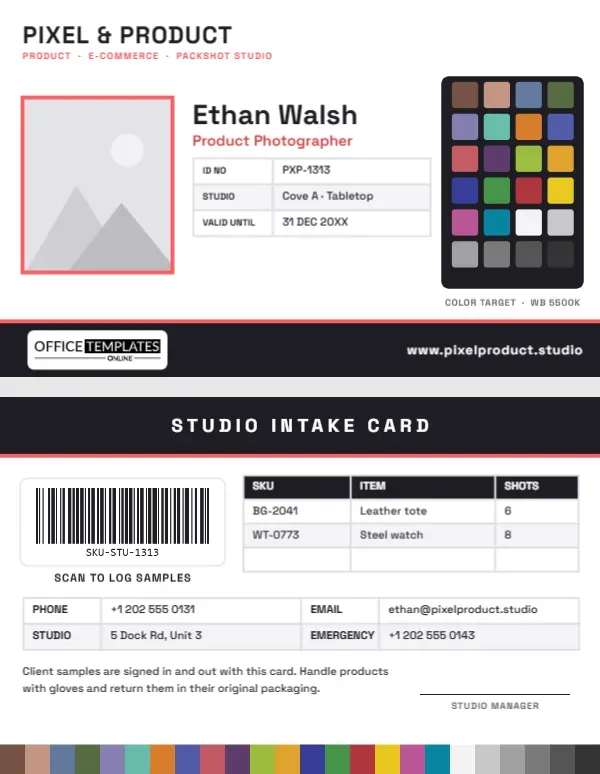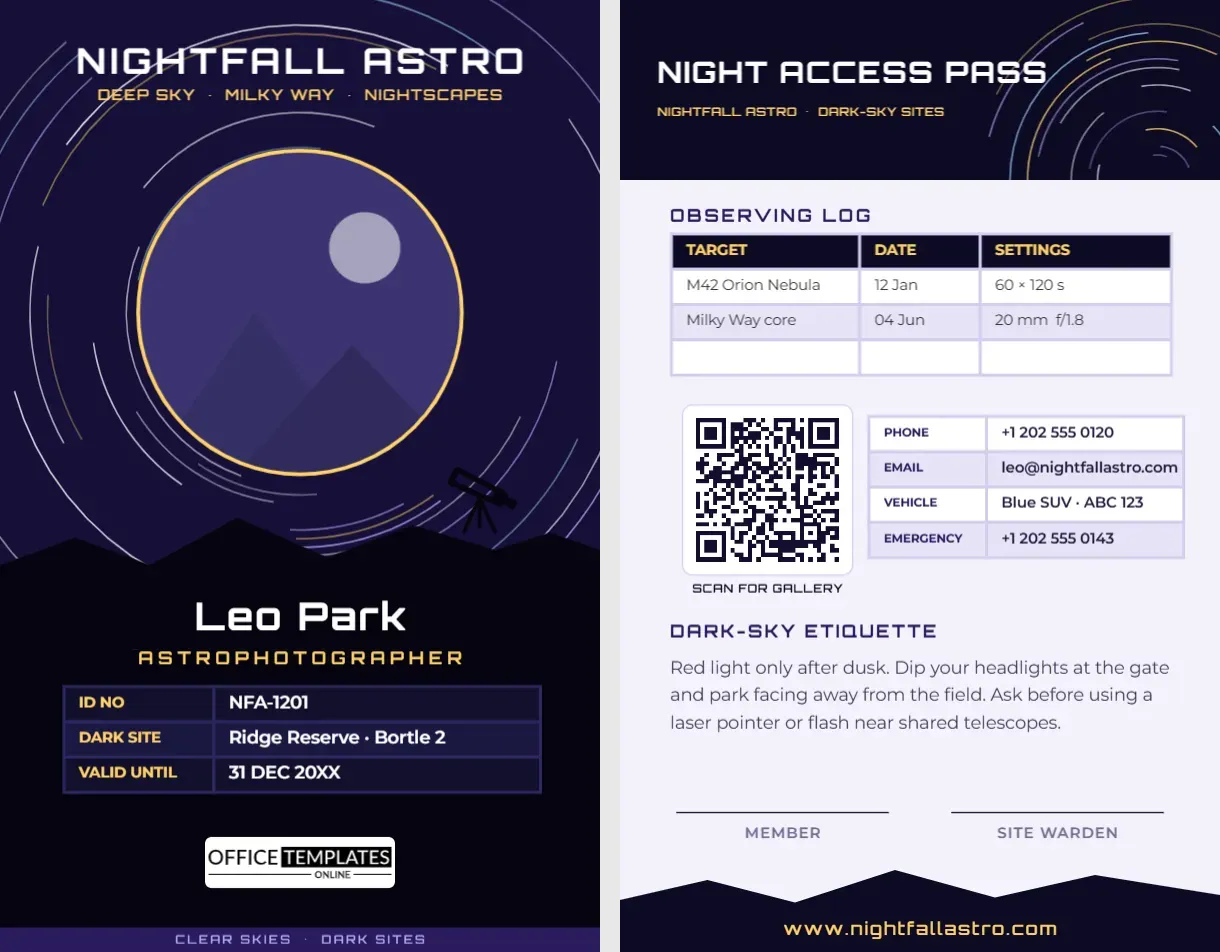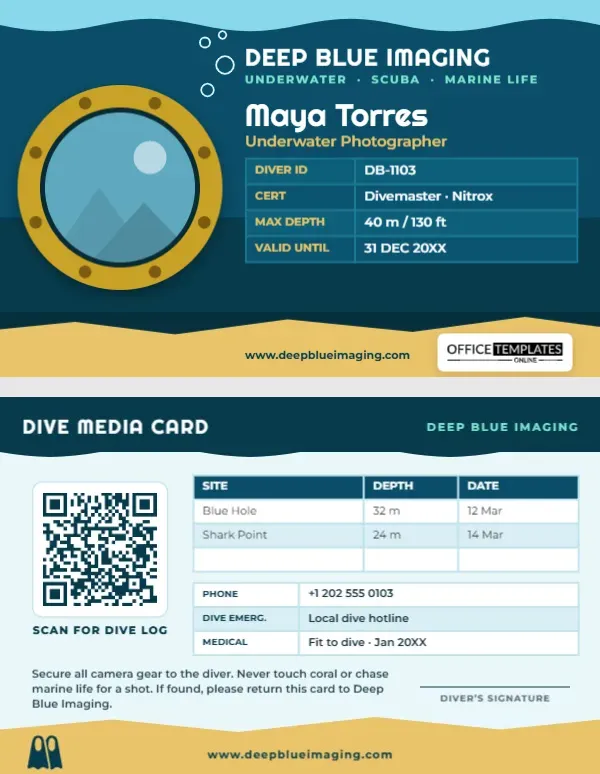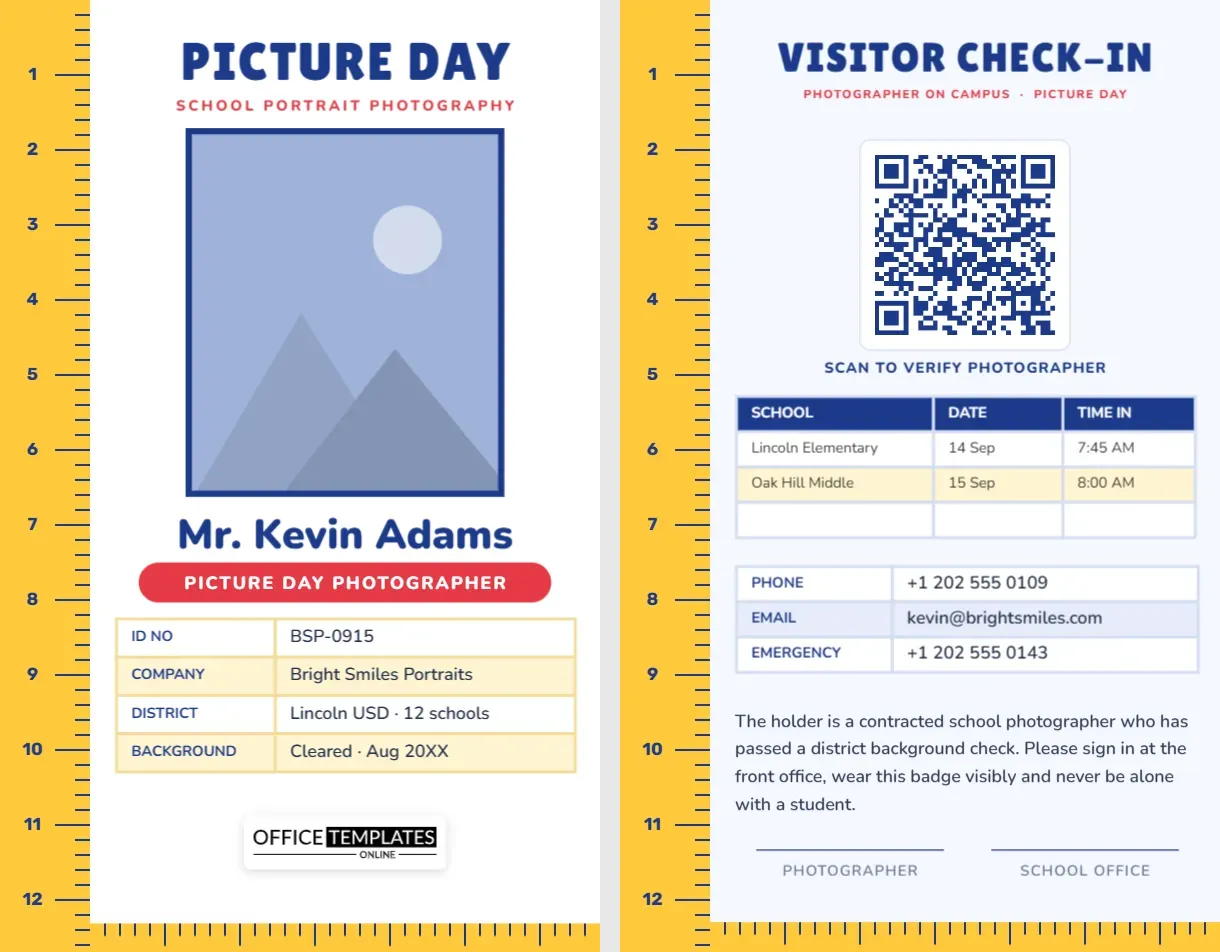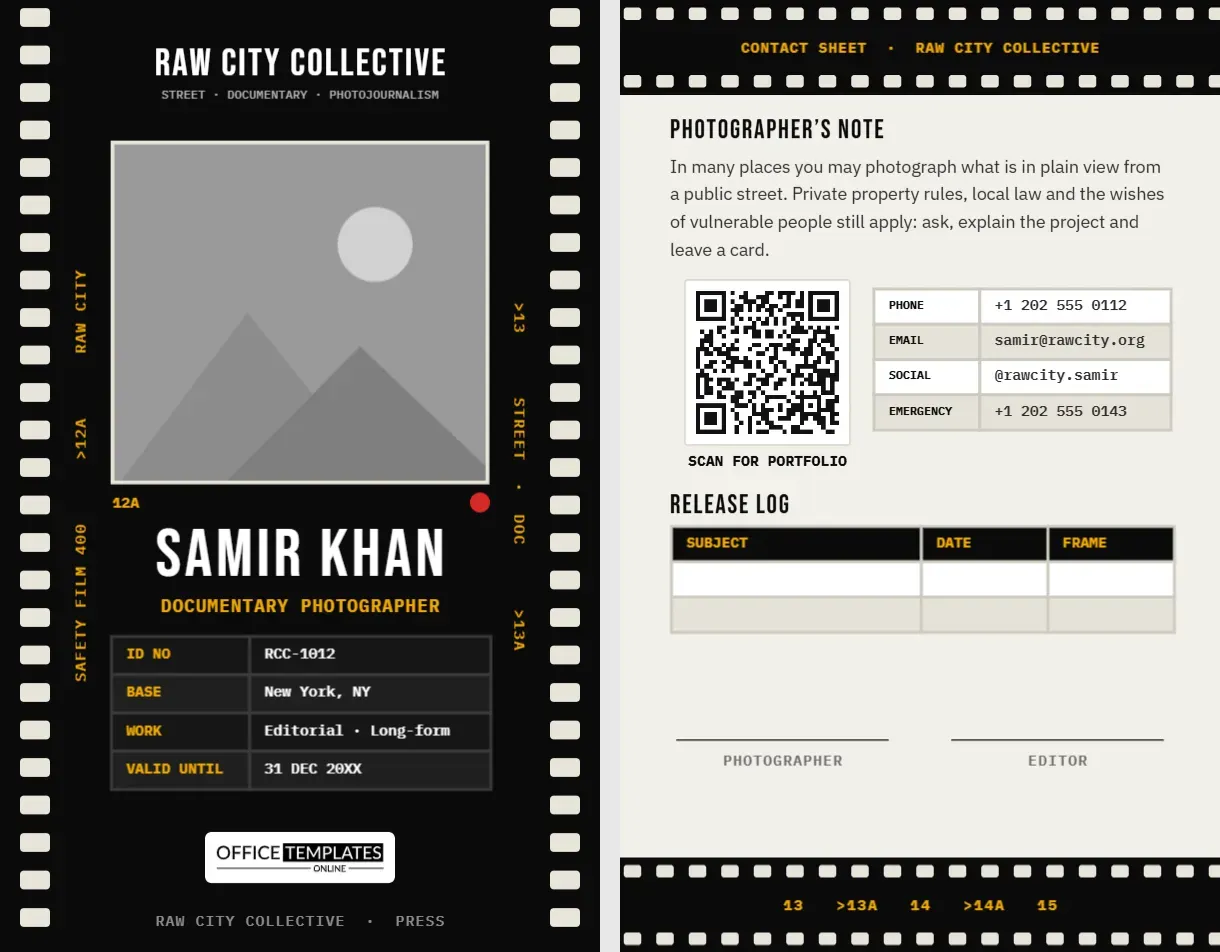
Street photography lives on trust given in a split second. You raise the camera, someone notices, and in the next heartbeat they decide whether you are an artist, a journalist, a tourist, or a threat. Most of the time, a smile is enough. Sometimes it is not, and that is when a proper card helps. This Street Photographer ID Card is made for documentary photographers, photojournalists, and members of street photography collectives who want a credential with the soul of the medium. It is designed as a strip of 35mm black-and-white negative film, and it carries a short note and a release log on the back for the moments when a conversation begins.
Cut From a Strip of Negative Film
The front is black from edge to edge, the colour of developed film base. Down both long sides runs a column of rounded, off-white sprocket holes, just like the perforations of 35mm stock. Between the holes and the picture, amber edge printing runs sideways: SAFETY FILM 400, a frame number of 12A, and on the opposite edge 13, STREET · DOC and 13A, the kind of lettering you find along every roll when you hold it up to the light.
In the middle of the frame, RAW CITY COLLECTIVE is set in tall Bebas Neue capitals, with Street · Documentary · Photojournalism in a small typewriter-style mono. Your photo sits in a thin cream border like a frame on a contact sheet; the placeholder is grey, and a black-and-white portrait keeps the whole card monochrome. Below it, the frame number 12A appears in amber on the left, and a single red dot sits on the right, the only splash of warm colour on the card. Your name is set huge in white Bebas Neue, SAMIR KHAN on the sample, with DOCUMENTARY PHOTOGRAPHER in amber mono beneath. A dark table in IBM Plex Mono lists your ID, your base city, the kind of work you do, and the expiry date. Our logo sits on a white plate near the foot of the card.
The badge follows the CR80 standard, 2.125 by 3.375 inches, in portrait.
When Someone Asks What You’re Doing
Every street photographer has these conversations. The card gives you something to show while you explain; here are a few calm replies that tend to work:
- Why are you taking my picture? I’m documenting life on this street for a project with Raw City Collective. Here’s my card. If you’d rather I didn’t keep it, I’m happy to delete it.
- Are you from the newspaper? I’m an independent documentary photographer. My work is on the site on the back; have a look.
- You can’t photograph here. Understood. Is this private property? I’ll step back onto the pavement or move on.
- Can I see the photo? Of course. Show the screen. People who see a respectful image often become your best subjects.
- Can I have a copy? Write their name in the release log on the back, and scan the QR code together so they can find your portfolio.
Contact Sheet, Note and Release Log
The back of the card is printed on a warm paper tone, like a contact sheet, with a strip of black film and sprocket holes across the top reading CONTACT SHEET · RAW CITY COLLECTIVE and another along the bottom with frame numbers 13 to 15. In between:
- Photographer’s Note: a short, reasonable statement: in many places you may photograph what is in plain view from a public street, but private property rules, local law, and the wishes of vulnerable people still apply, so ask, explain the project, and leave a card.
- QR code and contacts:Scan for portfolio beside a mono table with phone, email, social handle, and emergency number.
- Release Log: a real table with columns for subject, date, and frame, where you can write down people who agree to be photographed or who ask for copies.
- Signature lines for you and your editor or the collective’s coordinator.
The legal note is deliberately general. Laws about photographing people in public differ between countries, and rules on commercial use of someone’s image are stricter than rules on taking the picture. If you sell or publish images, learn the rules where you work and get written model releases when you need them.
Customising the Negative
- Portrait: click inside the cream-bordered frame and choose Replace Image. A black-and-white portrait matches the design best.
- Collective or agency name: retype RAW CITY COLLECTIVE. Freelancers can use their own name here and put their specialty in the table.
- Edge printing: the amber side lines are ordinary text boxes turned on their side; double-click to edit them, for example, to your city name or favourite film stock.
- Details and logs: select a table and click Edit Data. Add more release log rows with + Row if you work on long projects.
- QR code: link it to your portfolio, project page or social profile in the Barcodes & QR panel.
- Red dot: keep it, move it, or change it to amber; it is a single circle.
For Collectives, Workshops and Walks
The design suits more than solo street photographers. Photography collectives can issue it as a membership card, with the collective name at the top and a member number. Documentary students and photojournalism programmes can use it for field assignments. Photo walk organisers can give it to guides and volunteers, so participants know who to follow. Community archive projects, oral history teams and local newspapers commissioning neighbourhood portraits all benefit from photographers who carry something credible.
Printing a Black Card That Looks Like Film
Large black areas are the hardest thing for small printers, so for the best result, print on PVC with a card printer or order from a print shop. On a home inkjet, choose matte photo cardstock and allow the ink to dry fully before handling. Check that the sprocket holes stay off-white and do not pick up a grey tint. A clear rigid holder keeps the black surface from scuffing, and a slim lanyard or a clip on your camera strap keeps the card out of the way until you need it.
Street Shooters’ Questions
Is this a press card?
It is an identification card for you and your collective or agency. Official press cards are issued by press associations or employers in some countries; if you have one, carry it too.
Can I make it colour instead of black and white?
Yes. Put a colour photo in the frame and change the amber edge print to orange for a colour-negative look.
Are the sprocket holes editable?
They are grouped into one object, so you can recolour or remove all of them at once.
Open the template, add your portrait to the frame, and carry a card that starts conversations as well as your camera does.