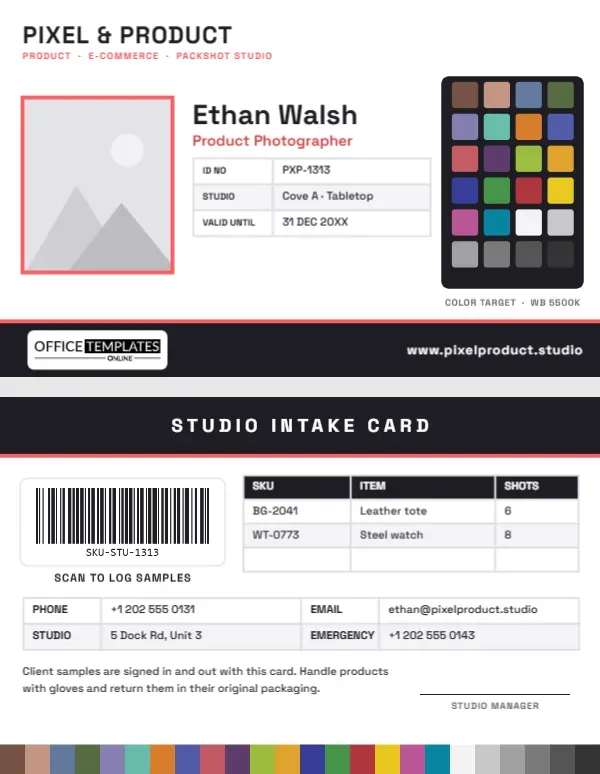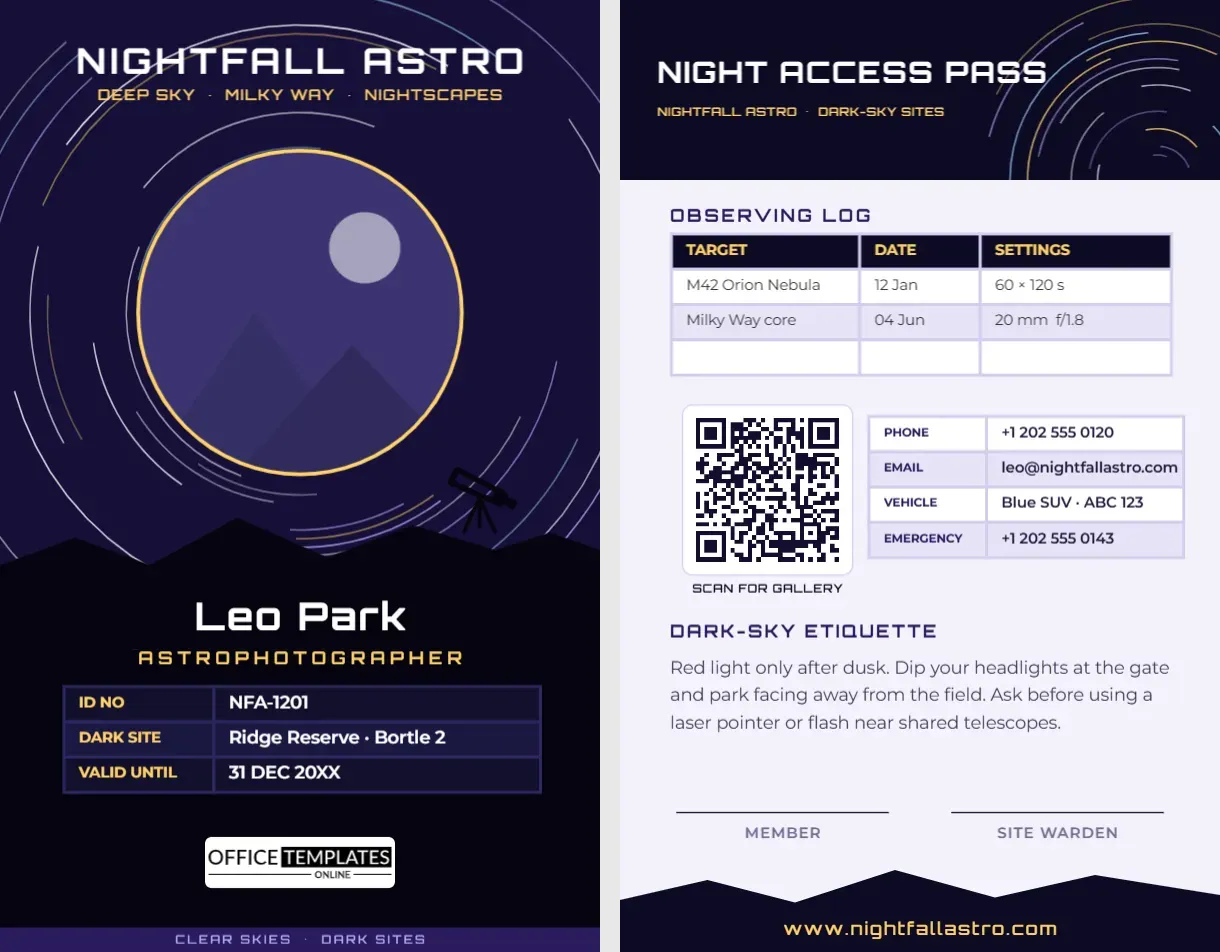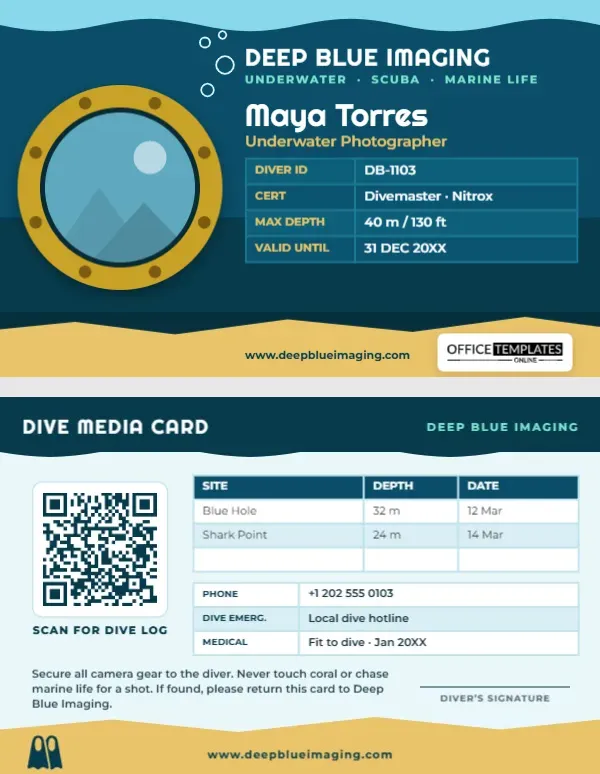
Out in the field, a wildlife photographer is often the only person around for miles, until a ranger’s truck pulls up beside your hide or a landowner walks across the meadow to see who is parked by the gate. A credential that explains itself without a long conversation is worth carrying. This Wildlife Photographer ID Card has the look of the job: your portrait framed inside the front element of a big telephoto lens, a ridge of mountains and pines along the bottom edge, and on the back a short code of field ethics that shows you care about the animals as much as the pictures.
Framed by the Lens You Carry
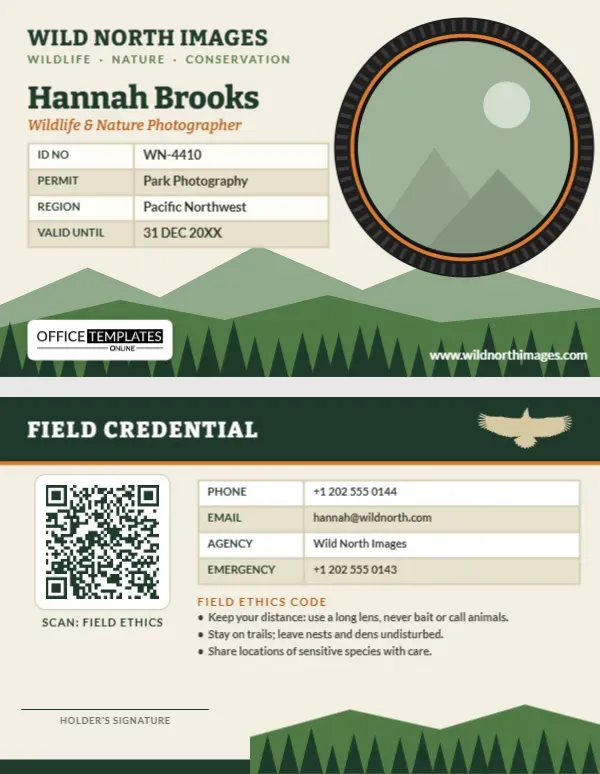
The card is horizontal, 3.375 by 2.125 inches, the usual CR80 format. On the right, your photo is round and sits inside what looks like the front of a super-telephoto lens: a thick charcoal barrel with a ribbed focus ring running all the way around it, a thin burnt-orange band like the accent ring on a professional lens, and a black inner rim. It is a motif every nature photographer recognises instantly, and it turns the usual photo box into something personal.
On the left, WILD NORTH IMAGES heads the card in bold Bitter slab-serif type, followed by Wildlife · Nature · Conservation in small moss-green capitals. Your name, Hannah Brooks on the sample, is set large in forest green with Wildlife & Nature Photographer in italic orange beneath. A four-row table on cream and khaki lists your ID number, the permit you hold, the region you cover, and the date the card expires.
The lower edge of the card is a landscape in three layers: pale sage mountains, a moss-green ridge, and a band of dark pine trees that runs the full width, with our logo on a white plate at the lower left and your web address in white along the bottom right. The whole palette of forest green, moss, sage, khaki, and cream is borrowed from the places you work.
What Rangers and Landowners Want to See
When someone approaches a wildlife photographer, they usually want answers to three questions: who are you, are you allowed to be here, and are you disturbing anything? The front answers the first two with your name, photo, organisation, and permit line. The back answers the third with the field ethics code. Showing a card that says keep your distance, never bait, leave nests undisturbed signals that you follow good practice before anyone has to raise it.
Permits and Passes You Might List
The PERMIT row on the front is deliberately flexible. Here are common entries and where they matter:
| What to write | When it applies | Tip |
|---|---|---|
| Park photography permit | Commercial shoots in some national, state or regional parks | Rules differ by park; confirm with the park office before each trip |
| Reserve or refuge access pass | Private reserves, bird observatories and wildlife refuges with restricted areas | Note the site name so staff recognise it |
| Landowner permission | Shooting from farmland, estates or private woodland | Keep the owner’s written permission on your phone |
| Hide or blind booking | Paid hides for birds of prey, kingfishers or mammals | Add the booking reference to the back |
| Research or survey affiliation | Photographing for a conservation group or university project | Name the organisation in the AGENCY row |
Permit requirements change and vary between countries and even between neighbouring parks. The card helps you present the permit you hold; it does not replace it.
The Field Credential Side
The back starts with a forest-green band reading FIELD CREDENTIAL, with an orange underline and a soaring eagle silhouette in khaki on the right. Below it:
- A QR code labelled Scan: field ethics, which you can link to your ethics statement, your portfolio, or the guidelines of a nature photography society you belong to.
- A contact table with phone, email, your agency or studio, and an emergency number, important when you work alone in remote places.
- The Field Ethics Code in three bullet points: keep your distance with a long lens and never bait or call animals; stay on trails and leave nests and dens undisturbed; share locations of sensitive species with care.
- A holder’s signature line on the left and the same mountain ridge and pines along the bottom right.
Swapping in Your Own Details
- Your portrait: click inside the lens and choose Replace Image. A photo of you with your camera, or even a favourite wildlife shot if you prefer, fills the circle.
- Studio or project name: retype WILD NORTH IMAGES and the tagline. Birders might write Birds · Wetlands · Migration; a marine naturalist might write Coasts · Seabirds · Seals.
- Table rows: select the table, click Edit Data, and update the ID, permit, region, and date.
- Ethics code: rewrite the three bullets on the back to match the code of a society or reserve you work with.
- Eagle: the eagle is an editable vector; recolour it from its swatch, flip it, or delete it.
- Trees and mountains: the pine band is a single group, and each mountain layer is one shape, so you can recolour them for autumn tones or a snowy blue-grey.
A Short Guide to Field Etiquette
A credential only earns trust if the behaviour behind it matches. When you are near wildlife, the animal’s welfare comes first: if it changes what it is doing because of you, you are too close. Approach slowly and indirectly, stay low, and use natural cover or a hide. Avoid flash on nocturnal animals and on birds at the nest. Do not post exact locations of rare or nesting species, since crowds can follow. Respect closed areas and seasonal restrictions, and leave gates as you found them. If a ranger or warden asks you to move, move, and thank them; they may well point you to a better spot.
Printing an Earthy Palette
The design leans on greens and a warm cream, which print naturally on uncoated stock. For a card you will keep in a waterproof jacket, print on PVC or laminate a matte cardstock print; lamination also protects it from rain and sweat. Check that the orange lens ring stays bright and that the dark pines do not merge into one black mass on your printer. A horizontal holder with a clip attaches easily to a camera strap or backpack shoulder strap.
Naturalist Questions
Can I use it as a birding club membership card?
Yes. Change the studio name to your club, the role to MEMBER, and the permit row to your membership number.
Can the lens photo show a bird instead of me?
You can, but for an ID card a clear photo of your face is more useful. A good compromise is a portrait of you holding your camera outdoors.
Will the QR code work on a small card?
Yes. It prints at a little over three-quarters of an inch; keep the link short and test it once printed.
Open the template, put your portrait in the lens, list your permit and region, and head into the field with a badge that speaks for you.