Forensic photographers work where precision and procedure matter more than anywhere else in photography. Every frame may end up in court, every entry to a scene is logged, and anyone inside the tape must be authorised. The credential a forensic photographer wears is part of that discipline. This Forensic Photographer ID Card is designed for crime scene units, forensic services departments, medical examiner offices, insurance and fire investigators, and forensic science training programmes. It combines a strong, recognisable crime scene theme with the formal details an official credential needs.
Scene Tape, Shield and Scale
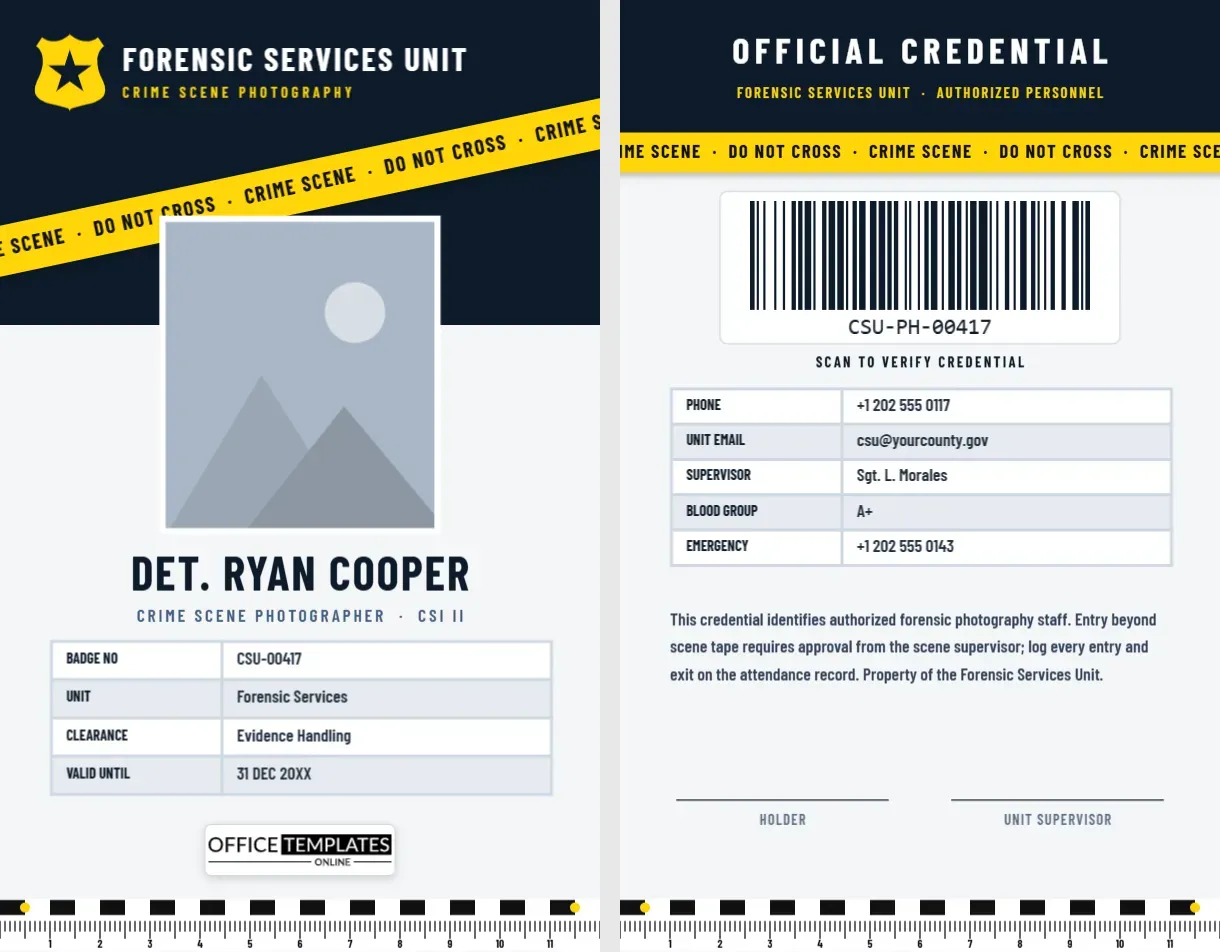
The top of the front is a deep navy block. In the top-left corner, a yellow badge shield with a star sits beside FORENSIC SERVICES UNIT in bold white Barlow Condensed, with CRIME SCENE PHOTOGRAPHY in spaced yellow capitals below it. A diagonal band of bright yellow scene tape runs across the navy block, printed with CRIME SCENE · DO NOT CROSS in black. Your photo, with a thick white border, overlaps the lower edge of the navy block so it sits in front of the tape.
The lower half of the card is a cool light grey. Your name and rank are set in large navy capitals, DET.RYAN COOPER on the sample, above Crime Scene Photographer · CSI II in steel blue. A four-row table lists your badge number, unit, clearance, and validity date. Our logo sits on a white plate, and along the very bottom edge runs an evidence scale ruler with alternating black and white centimetre blocks, millimetre ticks and numbers from 1 to 11, the kind of reference scale placed next to evidence in every close-up. It is both a subject motif and a tidy footer.
The card is a portrait CR80, measuring 2.125 by 3.375 inches, standard for official identification.
The Official Credential Side
The reverse starts with a navy header, OFFICIAL CREDENTIAL in white and Forensic Services Unit · Authorized Personnel in yellow, followed by a straight band of scene tape across the full width. Then:
- A large barcode in a white panel with Scan to verify credential, suitable for scene access logs and building entry systems.
- Contact table: phone, unit email, supervisor, blood group and emergency contact.
- Authority statement: the card identifies authorised forensic photography staff; entry beyond scene tape requires the scene supervisor’s approval; every entry and exit must be recorded on the attendance log; the card is unit property.
- Signature lines for the holder and the unit supervisor, and the evidence scale repeated along the bottom edge.
How Evidence Photographs Are Usually Sequenced
The ruler on the card is a reminder of one of the basic principles of forensic photography: every item is photographed so that its location and size can be understood later. Most training follows a sequence like this:
- Overall photographs of the scene from each corner and entry point, showing the layout before anything is moved.
- Mid-range photographs linking each item of evidence to a fixed feature, such as a doorway or piece of furniture.
- Close-up photographs of the item filling the frame, taken first without a scale.
- Close-ups with a scale placed beside the item, at the same level and with the camera parallel to it, so measurements can be taken from the image.
- A photo log recording each frame number, description, time, and photographer.
Procedures vary between agencies and countries; always follow your unit’s standard operating procedures.
Credential Details to Get Right
| Field | Recommendation |
|---|---|
| Name and rank | As it appears in official records, including title such as Det., Officer, or Mr./Ms. |
| Badge or staff number | Must match the barcode value exactly |
| Unit | The formal unit name used in reports |
| Clearance | Evidence handling, laboratory access, or scene access, as issued |
| Supervisor | The person who can verify the holder by phone |
| Validity | A fixed expiry date so lost or retired cards stop working |
Editing the Forensic Credential
- Photo: click the white-bordered photo and use Replace Image. Use a recent, front-facing photo against a plain background, following your agency’s ID photo rules.
- Agency name: retype FORENSIC SERVICES UNIT and the subtitle with your department’s official wording.
- Details: select a table, click Edit Data, and enter the holder’s information; add rows with + Row if your credential needs more fields.
- Barcode: in the Barcodes & QR panel, enter the badge number your access system uses.
- Shield: the shield is an editable vector. Recolour it, or replace it with your agency’s approved emblem where you are authorised to use it.
- Scene tape and ruler: each is a single group, so you can recolour the tape to blue for a police line look or delete it for a plainer card.
Suitable For
Police crime scene units and forensic identification sections, forensic science service providers, medical examiner and coroner photography staff, fire and arson investigators, insurance claims investigators, private forensic consultants, and criminal justice and forensic science students on placements or training exercises all use credentials like this. Training academies can use it for mock scene exercises, changing the role to TRAINEE and the unit to the course name.
Printing an Official-Looking Card
For operational use, print on PVC with a card printer; many agencies also add a holographic overlay or a magnetic stripe from their card supplier. The navy, yellow, and grey palette prints cleanly and stays readable in poor light. Test the barcode with the scanners your unit actually uses. For training or classroom use, laminated cardstock in a rigid holder is fine. Always follow your organisation’s rules on who may issue and carry identification.
Forensic Unit Questions
Is this card an official police ID?
No. It is a template. Only your agency can issue official identification, and agencies typically have their own approved designs and security features. Use it where your organisation permits, such as for civilian staff, training, or private practice.
Can I remove the words CRIME SCENE?
Yes. Edit the tape text to FORENSIC UNIT or SCENE ACCESS, or delete the tape groups entirely.
Why is the ruler in centimetres?
Metric scales are standard in forensic work in most places. You can ungroup the ruler and edit the numbers if you prefer inches.
Open the template, enter the holder’s details and badge number, and print a credential that is as precise as the work it represents.