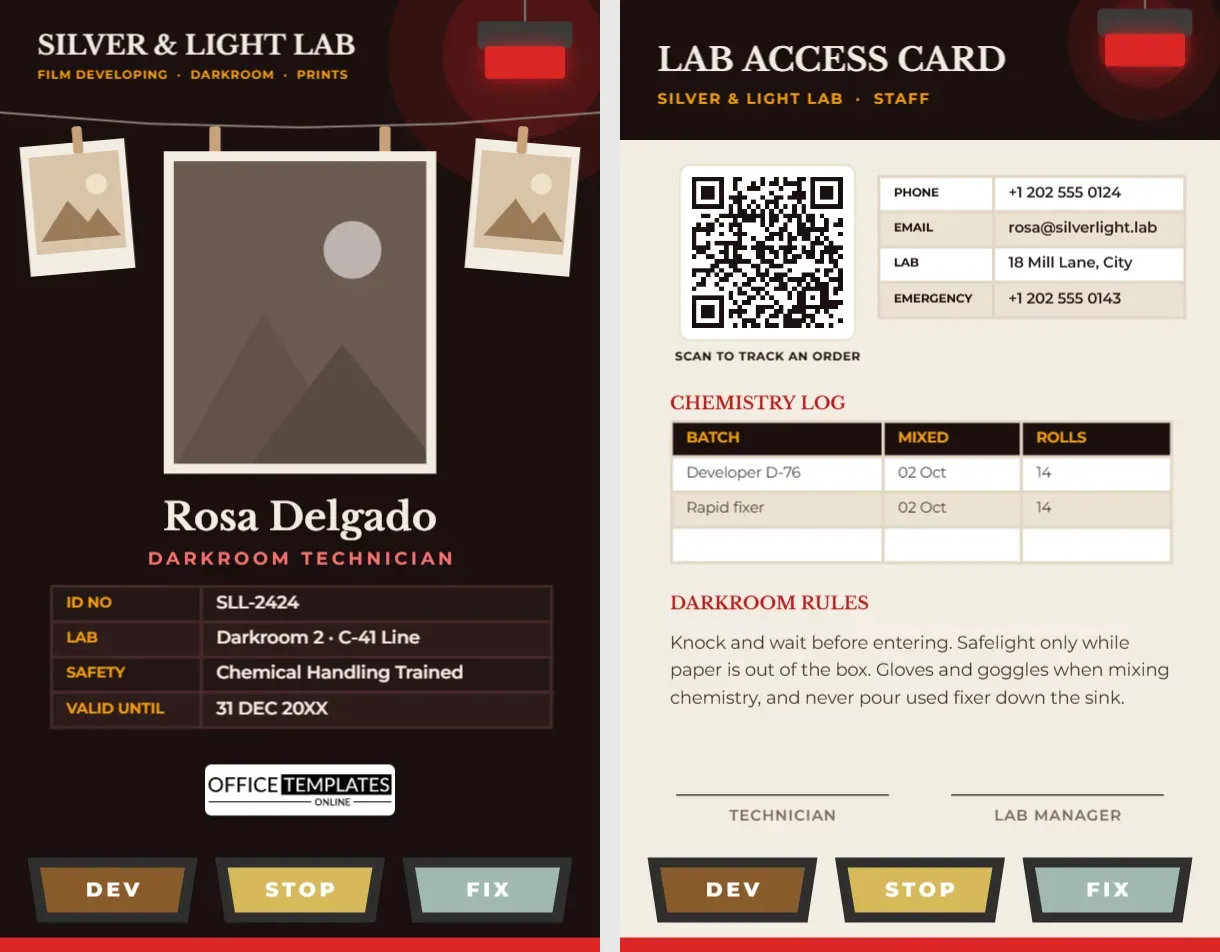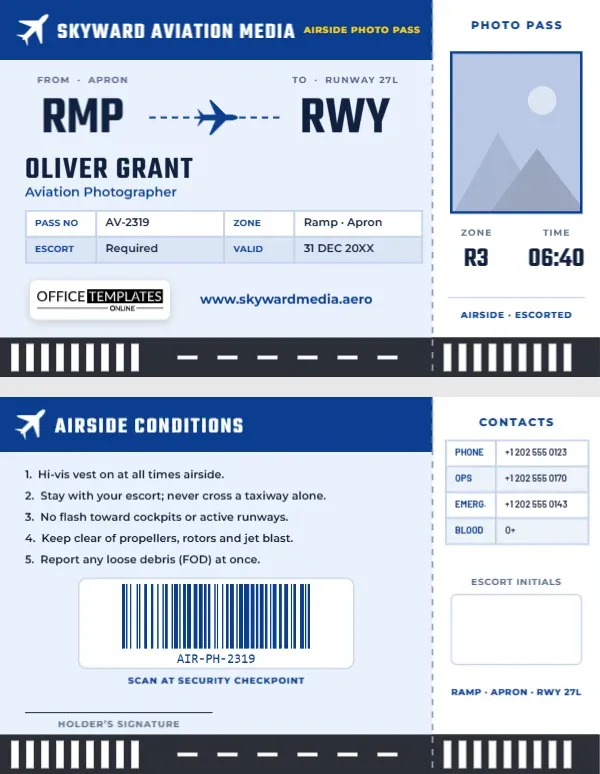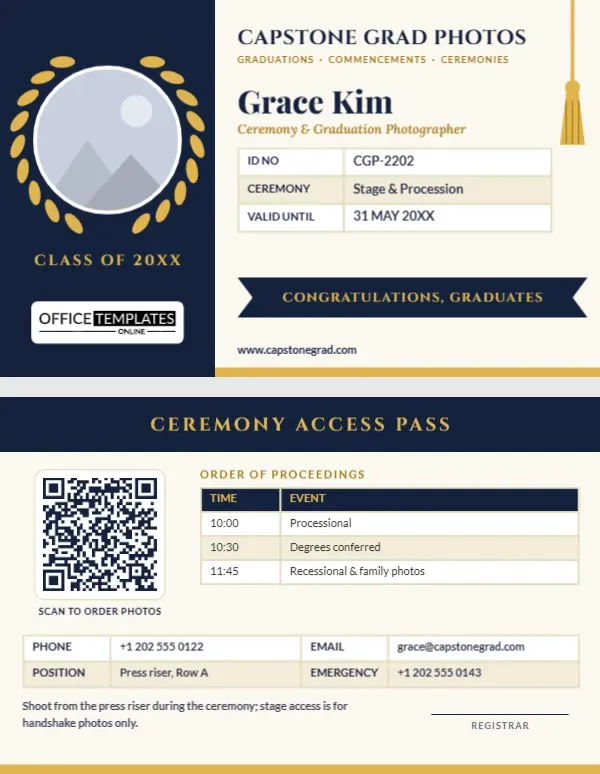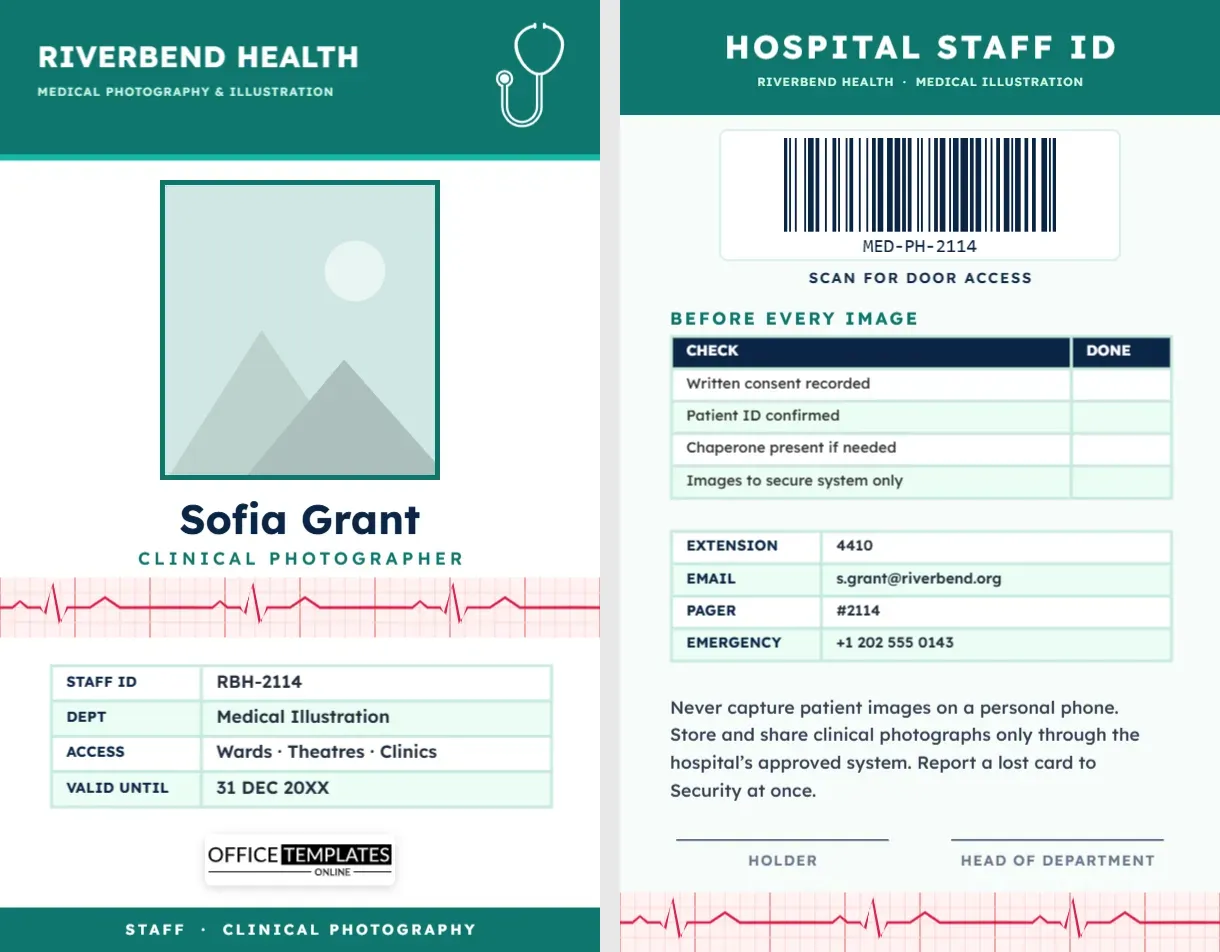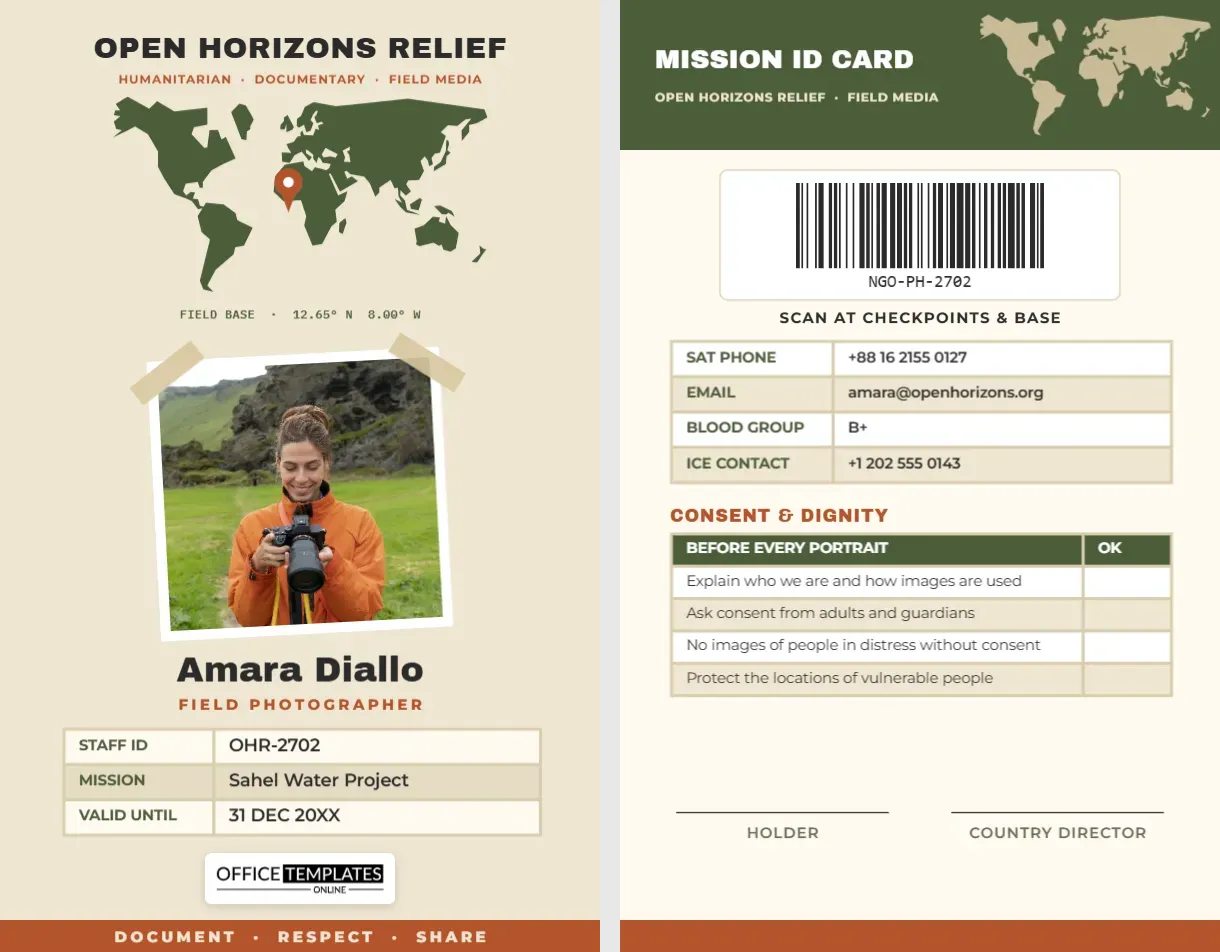
Photographers who work for charities, relief agencies and development organisations carry a heavy responsibility. Their images raise funds, shape how the world sees a crisis, and tell the stories of people who have often lost a great deal. In the field, they pass through checkpoints, register at base camps, and meet community leaders who want to know exactly who they are and why they are there. This NGO Field Photographer ID Card is designed for humanitarian photographers, communications officers and documentary storytellers. Its practical front shows your mission and field base; its back puts consent and dignity at the centre of the work.
A Map, a Pin and a Taped Field Print
The front has the earthy palette of fieldwork: sand, olive, rust and charcoal. OPEN HORIZONS RELIEF is set in bold Archivo Black at the top, with Humanitarian · Documentary · Field Media in rust. Below it, a solid olive world map spreads across the card, with a rust location pin marking the field base in West Africa, and the coordinates FIELD BASE · 12.65° N 8.00° W printed underneath in a typewriter-style mono font.
Your photo is presented like a print pinned into a field notebook: a white-bordered photo turned slightly on its axis, with two strips of paper tape at its top corners. Beneath it, your name, Amara Diallo, on the sample, is set in charcoal Archivo Black, with FIELD PHOTOGRAPHER in rust. A three-row table lists your staff ID, current mission (Sahel Water Project), and validity date. Our logo sits on a white plate, and a rust footer carries the words DOCUMENT · RESPECT · SHARE.
It is a portrait card in the CR80 size, 2.125 by 3.375 inches.
The Mission ID Side
The back is on a warm paper background with an olive header, where MISSION ID CARD sits beside the world map in sand. A large barcode labelled Scan at checkpoints & base works with base registration systems. A contact table lists a satellite phone, email, blood group, and an ICE (in case of emergency) contact, all critical when working far from home. Then comes the Consent & Dignity checklist, a real table with an OK column: explain who we are and how images are used; ask consent from adults and guardians; no images of people in distress without consent; protect the locations of vulnerable people. Signature lines for the holder and the country director complete the card.
Field Risks and How the Card Helps
| Risk | What to do | Where the card helps |
|---|---|---|
| Being questioned at checkpoints | Carry official permits and a letter from your organisation | Name, photo, mission and barcode on one card |
| Medical emergency | Share your blood group and emergency contact with the team | Blood group and ICE contact on the back |
| Loss of communication | Agree check-in times and a satellite phone number | Sat phone number printed on the card |
| Harm to people you photograph | Protect identities and locations of vulnerable people | Consent & dignity checklist |
| Misuse of images | Store images securely; share through the organisation | A clear, formal credential tied to your employer |
Principles of Ethical Humanitarian Photography
Most major aid organisations and photography associations agree on a few core principles. Photograph people as active, dignified individuals, not as symbols of suffering. Explain in a language people understand who you work for and where the images will appear, and accept a no without argument. Take extra care with children, survivors of violence, and people in detention or displacement, whose safety can depend on not being identifiable. Caption images accurately, with names only when people agree. And think about the long life of an image online: a photo that seems harmless today might put someone at risk later. The checklist on the back of this card turns these principles into a routine.
Preparing the Badge for a Deployment
- Photo: click the taped print and choose Replace Image. Use a clear, recent head-and-shoulders photo; officials will compare it to your passport.
- Organisation name: retype OPEN HORIZONS RELIEF and the rust tagline.
- Location: drag the pin to your field base and edit the coordinates line.
- Tables: select a table and use Edit Data for your ID, mission, and contacts. Add more checklist rows with + Row if your organisation’s policy has extra steps.
- Barcode: enter your staff number in the Barcodes & QR panel.
- World map: the map is an editable vector; recolour it from its swatch to match your organisation’s colours.
Relief Agencies, Charities and Journalists
The card suits international NGOs and their local partners, charity communications teams visiting projects, development organisations running monitoring and evaluation visits, faith-based relief organisations, volunteer photographers on short missions, and documentary photographers commissioned by charities. Local staff and national photographers, who do much of this work, can have cards in their own language by retyping the labels.
Printing for Harsh Conditions
Dust, heat and rain are hard on ID cards, so print on PVC wherever possible, or laminate a cardstock print with a thick pouch. The sand, olive and rust palette prints well and hides dust. Keep the card in a clear holder on a breakaway lanyard. In some places, a visible ID can attract unwanted attention; follow your security adviser’s guidance on when to wear the card openly and when to keep it out of sight.
Backing Up Images in the Field
Field images are often impossible to retake, so protect them. Carry more memory cards than you think you need and never format a card until the files are copied to two separate places, for example, a rugged portable drive and a laptop. Upload a selection over satellite or local internet when it is safe and permitted. Keep captions and consent notes with the files from the start; a photo without its context or consent record may be unusable later.
Field Media Questions
Can I use the card for a local charity rather than an international NGO?
Yes. Change the organisation name, remove the satellite phone row, and move the pin to your town.
Should I show the real field location?
Only if it is safe to do so. In sensitive areas, replace the coordinates with the country or region name.
Is the tape part of the photo?
No. The tape strips are separate shapes placed under the photo’s corners, so replacing the image keeps them in place.
Open the template, add your photo and mission, move the pin to your base, and carry a credential that puts people’s dignity first.